The Reverend William George Bird
Bill Bird as he was better known was born on 14th. February 1905 at 97 Ethel Street, a tenement block in Benwell in the heart of industrial Newcastle-upon-Tyne. Nearby were brick works which filled the air with smoke and soot from their coal fired kilns. His father Donald William Bird was a railway clerk to one of the lines that ran alongside the Tyne River servicing the factories. When his mother Martha Hann (née Nicholls) died at the end of 1909, he and his younger sister Pauline Robena Bird went to live with their paternal grandparents in the vicarage of St Mary Magdalene in Gilsland, a rural town on the border of Cumbria and Northamptonshire near Hadrian’s Wall.
His grandfather the Reverend William George Bird died at his father’s home in 1929 and his father died two years later in Newcastle-upon-Tyne. Bill trained to be a wireless operator probably at the No. 2 Air Force Training School in Digby Lincolnshire. Then he enrolled at his grandfather’s alma mater, King’s College London. After about eighteen months he was asked to withdraw. Wanting to be a priest but without much money and struggling academically he joined the Brotherhood of St Paul, Little Bardfield in October 1934. Situated in rural Essex northeast of London, the rector Edward Mears from 1910 until 1940 prepared some 300 men for ordination. They lived in the village and were instructed in ways Anglo-Catholic and mostly studied St. John’s Gospel in the original Greek.
Because this training was unacceptable to most English Bishops, they were ordained for positions “in the colonies.” Bishop Cherrington relied on them heavily in his early episcopacy ordaining some twelve for the diocese of Waikato. Bill was his tenth when he was ordained with Frederick Hart from St Augustine’s College Canterbury on 24th August 1936 in St Katharine’s Little Bardfield. The bishop continued his visit to England with his family, but Bill left on the final voyage of the RMS Ionic for New Zealand. He remained in Hamilton at the cathedral until he was ordained priest on Whit Sunday 1937. Then in mid July 1937 he began his ministry at St Andrew’s Inglewood. It must have been a happy time and when he left for the King Country in April 1939, the week before the official parish farewell Hoggard’s marching team entertained at a dance in the band room on the Saturday evening. Noeline Nodder and Pat Larmer provided the dance music. Briefly at Pio Pio, he then went to Ohura and returned at the beginning of 1941 to Inglewood. In April 1941 he accepted a position as curate at Christ Church Whanganui with the colourful Archdeacon James Rarity Young.
In Whanganui he met Ruth Jean Harman, the daughter of Stuart Jackson Harman, the owner of Harman Motors. SJ Harman was born in Christchurch and was married to Lavinia Sperring from Whanganui in 1905 by the Methodist minister. Jean Harman “the possessor of a beautiful contralto voice” regularly appeared on musical programmes in Whanganui during the 1930’s and later she would sing at weddings Bill conducted. Jean and Bill were married in St Chad’s Whanganui on the 12th. September 1942. Bill took his new bride to Waerenga-a-hika at the other end of the North Island. He had been appointed locum tenens for Ray Aires who had gone to serve as a military chaplain. Bill and Jean entered into the local social life midst the Second World War and priestly duties. In 1944 he moved to be locum tenens in the parochial district of Waikohu for another forces’ chaplain, Peter Blakiston.
It was while they were there that Bill became the driving force on the East Coast behind the Food-for-Britain campaign. The parish was broken into zones, with people responsible in each area. When Bill explained the scheme, R.D. Dymock presided at the first meeting in the Waikohu Hall and continued as the president; his wife was on the buying committee along with Jean Bird. Bill was to contact the vicar of Benwell (St James, the parish church where he was born in Newcastle) to arrange the distribution of food which was to go through the Colwyn Allocation Centre in North Wales. Newcastle was blitzed very early in World War 2, and about 30,000, mostly children, had been evacuated to the Lake District. The East Coast responded most generously as the Gisborne Herald reported on 24th. September 1948:
“The dispatch was made from New Zealand late last year and comprised 4 ½ tons of food assembled on behalf of the East Coast Food-for-Britain Committee by Messrs. Murray, Roberts and Company, Limited, through the firm’s Gisborne branch. The value represented by the consignment is £5OO, and each individual parcel contains one tin of meat, one of dripping, one of condensed milk, one of marmalade and 2 1b. of a cereal, together with a packet of soap-flakes and two tablets of soap. The photograph was received recently by the Rev. W. G. Bird, vicar of Waipiro Bay and honorary organiser of the East Coast Food - for - Britain Committee, direct from London by air-mail.”
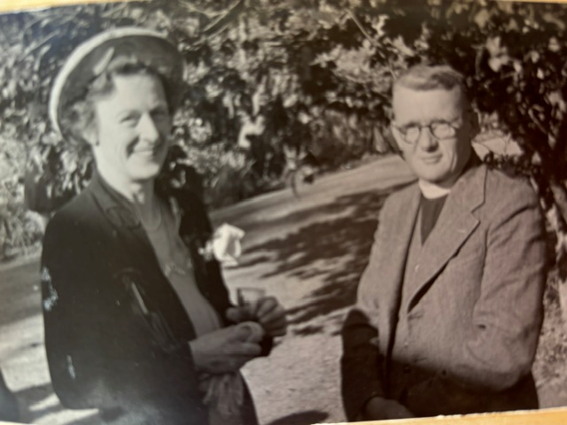
Bill Bird probably with wife Jean from the wedding album of RD Dymock’s son, John Dymock &
Jane Seymour whose marriage he conducted 9th October 1946 in Holy Trinity Gisborne
From Te Karaka they moved as locum tenens to Tolaga Bay briefly. In 1947 Bill was appointed vicar of Waipiro, his first permanent position, somewhere to settle with Jean at last. But this was not to be. With the motor lorry, coastal shipping declined and the wharves at Tokomaru, Waipiro and Tolaga Bays saw less freight as Ruatoria became the new business centre. They oversaw the building of the vicarage in Ruatoria to replace the one at Waipiro Bay in much need of repair. Bill entered this new enterprise with great vigour. However, the church of St Francis hadn’t been completed when they moved to St Andrew’s at Port Ahuriri in 1952. Eighteen months later, on 4th. September 1953, Bill died aged 48 at Napier hospital and after St. Francis was dedicated his ashes were placed under the altar. Jean died on 23 February 1980 in Gisborne and what became of her ashes is unknown. They had no children.
Robert Bruère 18 July 2026


Comments