Reflection by The Rev'd Dr Deborah Broome
- Apr 16
- 5 min read
Known in the breaking of the bread
Now on that same day two of them were going to a village called Emmaus, about seven miles from Jerusalem, and talking with each other about all these things that had happened. While they were talking and discussing, Jesus himself came near and went with them, but their eyes were kept from recognizing him. And he said to them, “What are you discussing with each other while you walk along?” They stood still, looking sad. Then one of them, whose name was Cleopas, answered him, “Are you the only stranger in Jerusalem who does not know the things that have taken place there in these days?” He asked them, “What things?” They replied, “The things about Jesus of Nazareth, who was a prophet mighty in deed and word before God and all the people, and how our chief priests and leaders handed him over to be condemned to death and crucified him. But we had hoped that he was the one to redeem Israel. Yes, and besides all this, it is now the third day since these things took place. Moreover, some women of our group astounded us. They were at the tomb early this morning, and when they did not find his body there they came back and told us that they had indeed seen a vision of angels who said that he was alive. Some of those who were with us went to the tomb and found it just as the women had said, but they did not see him.” Then he said to them, “Oh, how foolish you are and how slow of heart to believe all that the prophets have declared! Was it not necessary that the Messiah should suffer these things and then enter into his glory?” Then beginning with Moses and all the prophets, he interpreted to them the things about himself in all the scriptures.
As they came near the village to which they were going, he walked ahead as if he were going on. But they urged him strongly, saying, “Stay with us, because it is almost evening and the day is now nearly over.” So he went in to stay with them. When he was at the table with them, he took bread, blessed and broke it, and gave it to them. Then their eyes were opened, and they recognized him, and he vanished from their sight. They said to each other, “Were not our hearts burning within us while he was talking to us on the road, while he was opening the scriptures to us?” That same hour they got up and returned to Jerusalem, and they found the eleven and their companions gathered together. They were saying, “The Lord has risen indeed, and he has appeared to Simon!” Then they told what had happened on the road and how he had been made known to them in the breaking of the bread. Luke 24:13-35
This takes us back to the evening of Easter day. Early that morning Mary Magdalene and some other women discovered the empty tomb. Now two of Jesus’ followers are walking to Emmaus and talking about the news. For them at this point resurrection is only a rumour, “an idle tale,” something they’ve heard about but don’t know for themselves. Maybe that sounds like you. Cleopas and his wife are walking along, and suddenly they’re joined by a stranger: it’s Jesus but they don't recognise him. He asks them what they’ve been talking about, and the story pours out of them. “Are you the only stranger in Jerusalem who does not know the things that have taken place there in these days?” When we’re in the middle of something big happening to us we can’t believe there are people in the world who are unaware of it.
They tell the stranger about Jesus being handed over to be crucified: “We had hoped that he was the one to redeem Israel.” “We had hoped” – some of the saddest words we can ever say. Sometimes we can be like Cleopas and his wife: so full of doubt, disillusionment, and despair that we give up hoping. The good news for Cleopas and his wife is that Jesus comes to them in the middle of their disappointment, meeting them on their journey. The irony is that they fail to recognise him. They don’t recognise him in the stranger who joins them on the road. They’ve missed seeing him in the Scriptures. And even when Jesus was alive they hadn’t grasped the reality of who he was: they describe him as “Jesus of Nazareth, who was a prophet mighty in deed and word before God and all the people.” Interestingly that’s what many people today say about Jesus “oh, he was a prophet and a teacher and someone who helped people” but they (just like Cleopas and his wife) miss the reality of who he was.
But that’s where there’s such good news in this story: for Cleopas and his wife, for us and for the people around us. Christ came to Cleopas and his wife in their doubt, disillusionment, and despair: he didn’t limit his resurrection appearances to those who were sure and certain about him, about God, about life in general. Christ came, and Christ still comes, to the despairing, to the disillusioned, to those who’ve given up hoping. He comes to those who don’t know their Bibles, to those who don’t recognise him, to those who’ve have given up and are heading back home. He comes to everyone facing an uncertain future. He wants to meet us on all our journeys, to show us who he is. And he wants to come in and be at home with us.
In some ways Cleopas and his wife are the church in miniature. Even those of us who’ve walked with Christ for a while sometimes don’t recognise him. But when we invite him into our homes something amazing can happen. As they came near where they were going the stranger walks ahead, as if he was going on, but Cleopas and his wife invite him in. Jesus was at the table with them, he took bread, blessed and broke it, and gave it to them – and only then did they recognise him. Why was that? Perhaps it’s a reflection that for Luke eating is the most Jesus thing. It’s been said that throughout Luke’s Gospel Jesus is either at a meal, on his way to a meal, or coming from a meal. Sharing food and drink around a table is what Jesus does, so perhaps that is why it’s his breaking bread that reveals his presence to Cleopas and his wife.
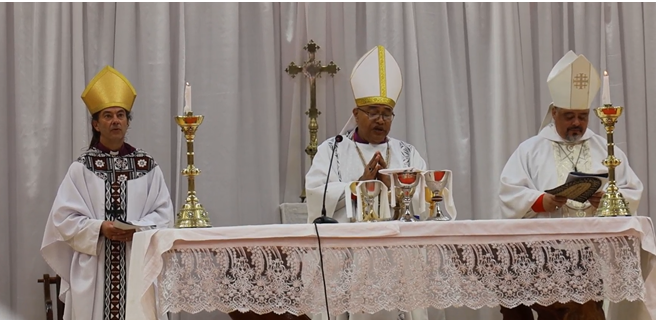
Suddenly Jesus vanishes from their sight. Overcome with joy they race out and return to Jerusalem to share the good news with the other disciples. “Then they told what had happened on the road, and how he had been made known to them in the breaking of the bread.” We too meet Jesus in the breaking of the bread, we encounter him in the Eucharist. And that encounter leads us – as it did Cleopas and his wife – to mission, to sharing with others the story of who Jesus is.


Comments