Reflection by The Rev'd Dr. Deborah Broome
- Feb 25
- 4 min read
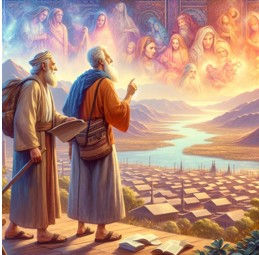
Journey Into the Unknown
Now the Lord said to Abram, “Go from your country and your kindred and your father’s house to the land that I will show you. I will make of you a great nation, and I will bless you and make your name great, so that you will be a blessing. I will bless those who bless you, and the one who curses you I will curse, and in you all the families of the earth shall be blessed.” So Abram went, as the Lord had told him, and Lot went with him. Abram was seventy-five years old when he departed from Haran. Genesis 12:1-4
Beginnings are often filled with uncertainty. In Genesis, we meet a family just starting out on a path to a new way of life and a new relationship with God. The story will one day grow wide enough to include us, though no one at that time could have foreseen that. Most of us know something of the hesitation and hopefulness of an uncertain beginning. God’s call to Abram is stark and unsettling: “Go from your country and your kindred and your father’s house to the land that I will show you.” Leave behind all that’s familiar and secure, and step into a future not yet revealed.
Abram sets out without a map and without the reassurance of knowing the destination. It’s hard to imagine anything more daunting. Yet Abram goes – “as the Lord had told him.” He doesn’t argue or bargain. He doesn’t point out his age or the upheaval this will cause. He goes. When was the last time we stepped out of the familiar in response to God’s prompting? If it’s been a long time, it might be worth asking whether we’ve grown too comfortable. God’s people are continually called onward. And I think I know why God so often works through unfamiliar territory. When life is predictable, we tend to run on autopilot, confident in our own routines and abilities. But when we’re pushed into something new – something that strips away our self-reliance – we find ourselves leaning on God in a deeper way.
We’re told almost nothing about why Abram was chosen. No virtues or qualifications are listed. But as the story continues, it becomes clear that trust is the defining quality of Abram’s faith. He simply believes God’s promise. Paul later looks back to Abraham as the model of faith: a relationship grounded not in achievement but in trust. Abram steps into the unknown with nothing but a promise to hold onto.
And that promise is far bigger than he is. God promises land, descendants, and blessing. Throughout his life, Abram crosses and re‑crosses the land he has been promised, hearing God repeat the assurance each time. Yet he never fully owns it; even late in life he’s still “a stranger and an alien” living among others. Still, the promise stands. And the promise extends across generations, eventually to us. Abraham becomes the shared ancestor of Judaism, Christianity, and Islam, reminding us we belong to a vast family and that our treatment of others, especially strangers, must be shaped by the memory that our spiritual ancestor was once an immigrant.
God’s words to Abram are striking: “I will bless you… so that you will be a blessing.” Blessing is never meant to end with the one who receives it. Abram and his wife Sarai (later, Sarah) are blessed so that others may be blessed through them. The same is true for us. The Church never exists for itself alone. As Archbishop William Temple famously said, the Church exists for the benefit of those who are not its members. The gifts we receive – community, meaning, purpose, the knowledge of being loved by God – are given so we may share them.
Abram’s journey was lifelong. He followed God’s call not only in one decisive moment, but in countless ordinary moments afterwards. Like Abram, we cannot see the entire path ahead. The wind of God’s Spirit “blows where it chooses,” often unsettling as well as exhilarating. But uncertainty doesn’t mean we’re alone. We travel with companions in faith, and we travel with the God who calls, blesses, guides, and holds us. That’s faith. That’s trust. That’s a relationship with God which says that as long as we know God is with us, and we are with God, where we’re going and how long it takes to get there doesn’t matter.
Do you know the poem that goes like this:
‘And I said to the man who stood at the gate of the year:
‘Give me a light, that I may tread safely into the unknown!’
And he replied:
‘Go out into the darkness and put your hand into the Hand of God.
That shall be to you better than light and safer than a known way.’
So, I went forth, and finding the Hand of God, trod gladly into the night.’
Minnie Louise Haskins, first published in 1908.
Abraham would have understood that. The question for us is: do we?


Comments